Quick and Easy Gravity Investigations

Teaching students about gravity doesn’t have to be difficult. Here are 4 stations I have students complete to teach them about gravity and how it pulls objects towards Earth.


Total Time: 30 minutes


Materials:

  • Pencils or other small objects to let fall to the ground
  • Paper
  • Pop Up Balls


For these activities, have students work in groups of 2-3 so they can discuss findings.

Investigation 1 Steps:

  1. Get a small object like a pencil or something similar.
  2. Drop the pencil or object from waist height.
  3. Drop the pencil or object from shoulder height.
  4. Raise your hand above your head and drop the pencil or object.

Investigation 2 Steps:

  1. Push a pencil or small object off a desk.
  2. Find another location in your classroom you can push a pencil or object off of.
  3. Find one more location in your classroom you can push a pencil or object off of.

Investigation 3 Steps:

  1. Hold both pieces of paper and drop them at the same time.
  2. Crumple only one of the pieces of paper and drop both at the same time.
  3. Crumple the second piece of paper and drop them at the same time.

Investigation 4 Steps:

  1. Grab a popper and flip it inside out.
  2. Very carefully place it on the ground and hold it there until you are ready.
  3. When ready, release the popper. Keep it away from your face.

After each investigation students should write down what they observed and what it shows scientifically.


For example:
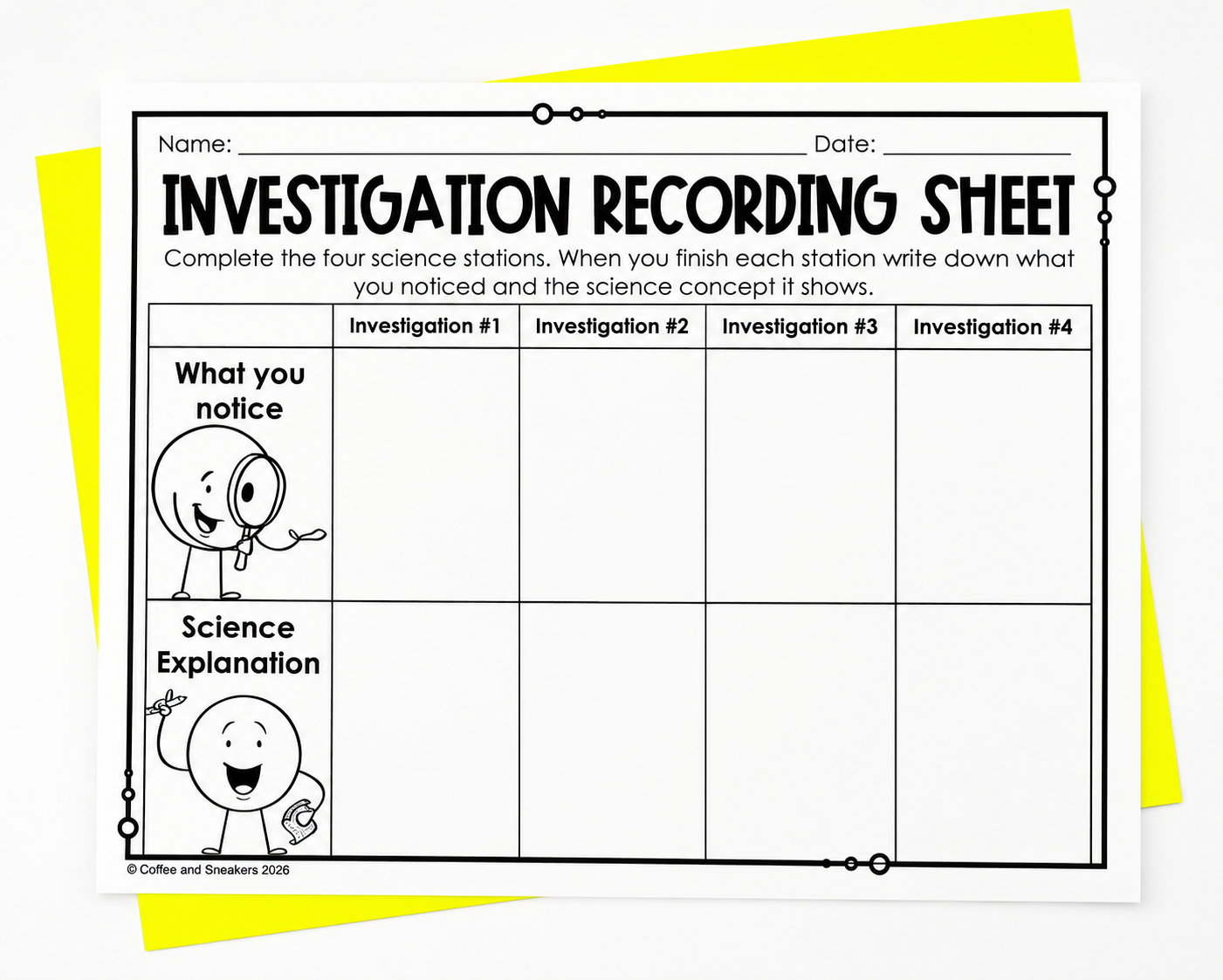
  • What they notice: The objects fall to the ground no matter where we are in class.
  • Science Explanation: Whatever is pulling the objects down happens everywhere


FAQ

What questions can I ask students to help them understand what is happening?

As you walk around the room checking in on different groups, you can ask the following questions to students.

  • What is happening?
  • Does it always happen the same way?
  • What is causing the object to move?
  • Why do you think the same thing happens?
  • Do you notice any patterns?


How can English learners participate successfully?

Here are some tips for English learners:

  • Let them write their ideas in their native language (if they can). If they cannot, let them draw in the observation box instead of writing.
  • Partner them up with someone who can help them record their thoughts on paper.
  • Use AI to help create a visual support to help the student understand the instructions. Here is a prompt: “Take these instructions and turn it into a visual support (PNG) for EL students: Investigation 3 Steps: Hold up both pieces of paper and drop them at the same time. Crumple only one of the pieces of paper and drop both at the same time. Crumple the second piece of paper and drop them at the same time.”


What pop up toys are you talking about?

You could really use any type of object that pops up but then comes back down. But we used these pop up balls*. 


No need to use the same exact object as us. Use whatever you can find that is free, even a bouncing a rubber ball will show students the same scientific principle. We just want to share the resources we used that worked well.

Forces and Interactions Lesson Plan Cover

Looking for ready-to-use lessons on this subject? This activity is part of our 3rd Grade Forces & Interactions Lesson Plans, which include detailed lesson plans, student recording sheets, assessments, and many other activities to help students understand forces, gravity and friction.


*As an Amazon Associate, we earn from qualifying purchases.

A thunderstorm to teach students about weather
August 18, 2026
Discover a simple way to teach weather by tracking and graphing daily conditions, using real-time data to build vocabulary and science skills.
Elephant toothpaste science experiment producing colorful foam
August 17, 2026
Explore matter, physical and chemical properties, and chemical changes with an exciting elephant toothpaste science experiment for kids.
Students exploring their school during a science scavenger hunt to find real-world examples
August 17, 2026
Discover how science scavenger hunts make hands-on learning easy and engaging, with simple activities for exploring matter, forces, and more.
Students completing a Stroop Effect experiment
August 17, 2026
Try the Stroop Effect for kids! This fun brain experiment explores attention, the nervous system, and how our brains process competing information.
Studnets using open and closed sorting activities to help students classify information
August 16, 2026
Closed sorts vs. open sorts: discover how both strategies help students classify, identify patterns, explain their thinking, and develop deeper science reasoning.
Toy monster truck on top of four  ramps covered with different surfaces— bubble wrap, sandpaper
July 21, 2026
Teach friction with this engaging investigation! Students compare toy car speeds on ramps covered with sandpaper, bubble wrap, and aluminum foil.
ecosystem tri-fold display board created by students for an Ecosystem Expo science project
July 20, 2026
Looking for a meaningful ecosystem project? Learn how to host an Ecosystem Expo where students research biomes, create displays, and present their learning.
Student creating a human body systems poster using craft supplies to model organs and body systems d
July 12, 2026
Discover hands-on human body system projects that help students explore the skeletal, muscular, digestive, respiratory, and more using simple craft supplies.
Variety of balls used in a hands-on force and motion investigation exploring how mass affects an obj
July 6, 2026
Teach force and motion with hands-on science activities that explore how force strength and mass affect movement using simple materials.
Coin resting on an index card over a plastic cup for a hands-on Newton's First Law of Motion
July 6, 2026
Teach Newton's Laws of Motion with quick, hands-on science activities using simple materials. Perfect for engaging elementary students.